Journal of Oil Palm Research Vol. 33 (3) September 2021, p. 514-523
PREDICTION OF ACID, PEROXIDE AND TBA VALUES OF HEAT-TREATED PALM OIL USING A PARTIAL LEAST SQUARES–ORDINARY LEAST SQUARES MODEL BASED ON FOURIERTRANSFORM INFRARED SPECTROSCOPY
DOI: https://doi.org/10.21894/jopr.2020.0106
Received: 15 December 2019 Accepted: 6 September 2020 Published Online: 30 November 2020
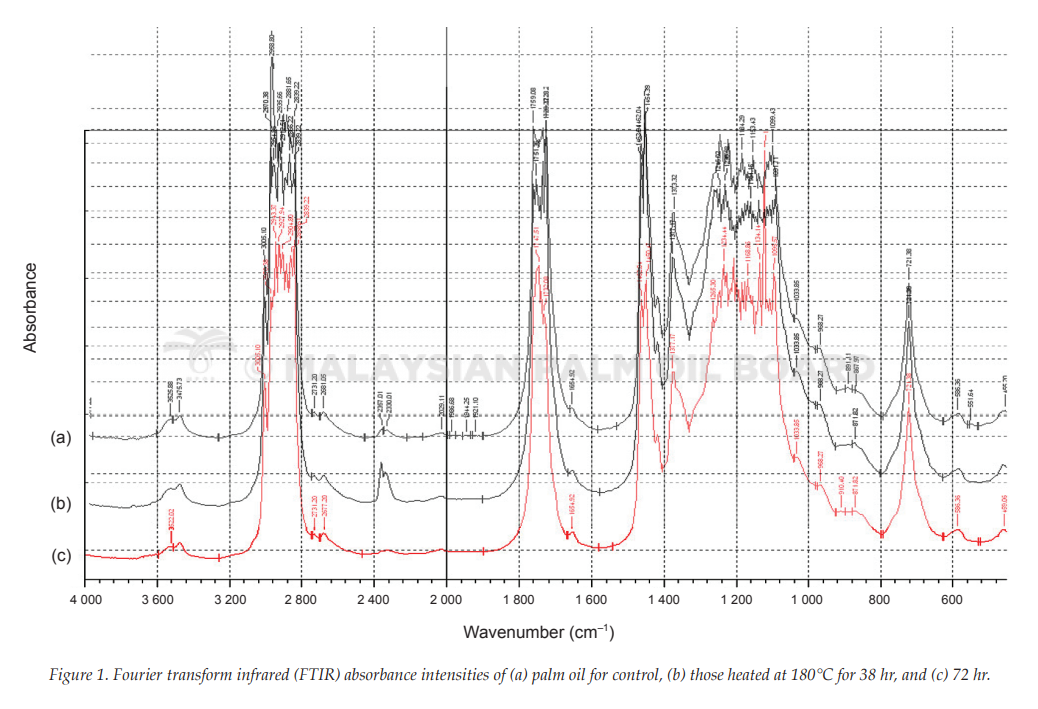
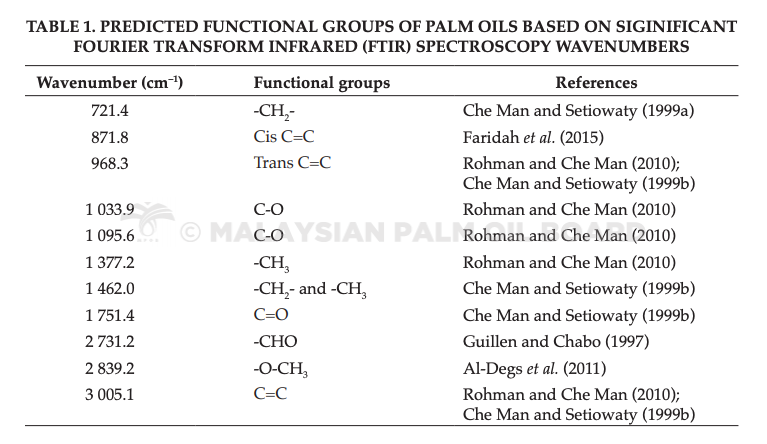
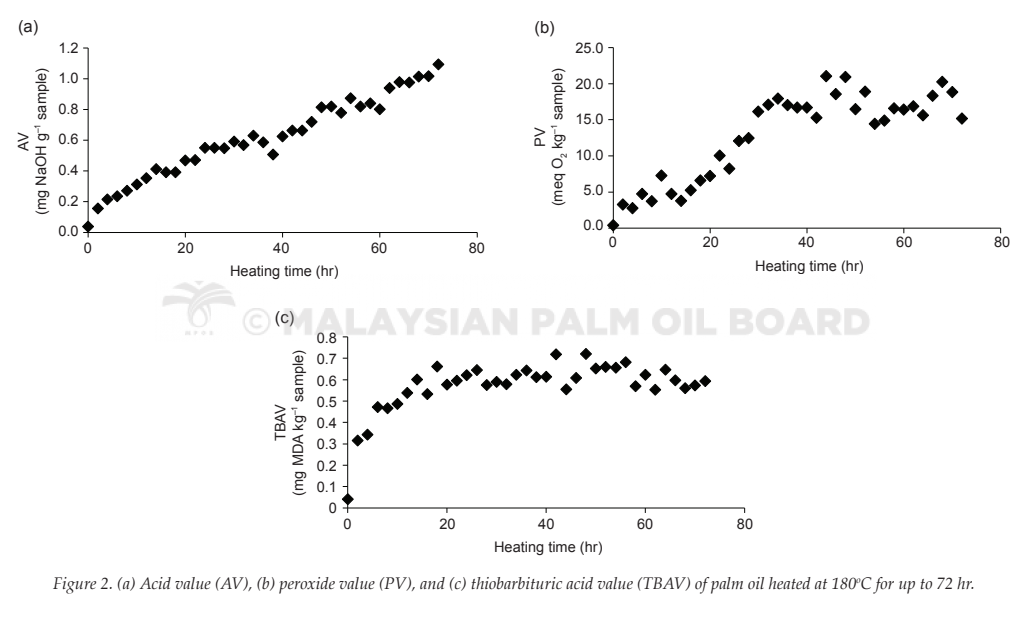
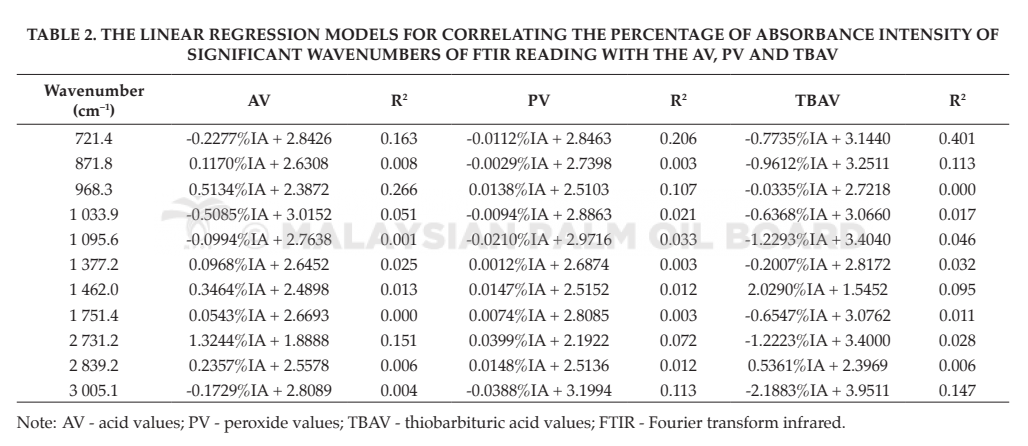
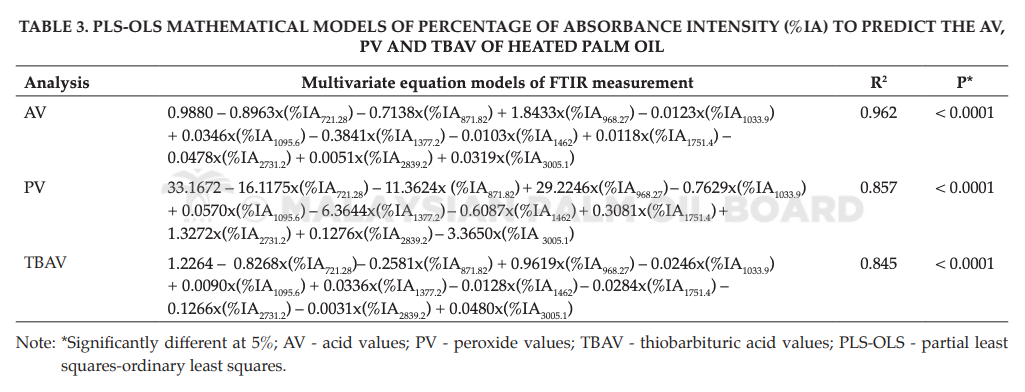
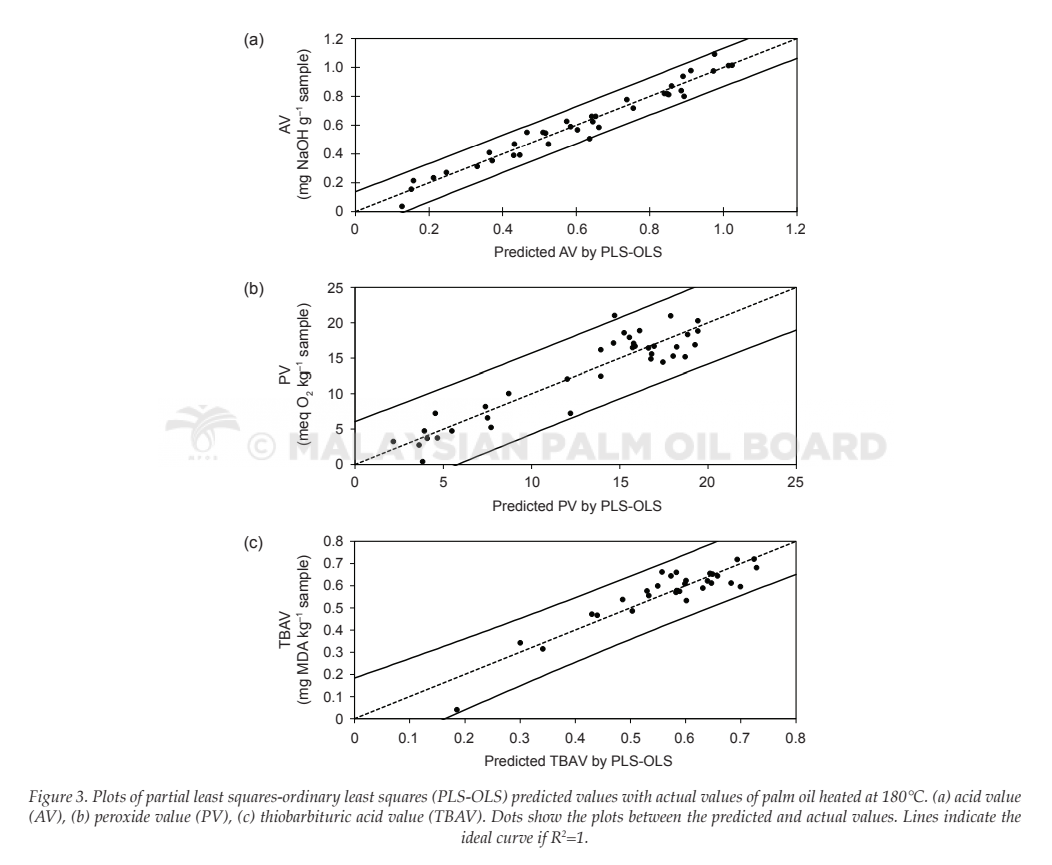
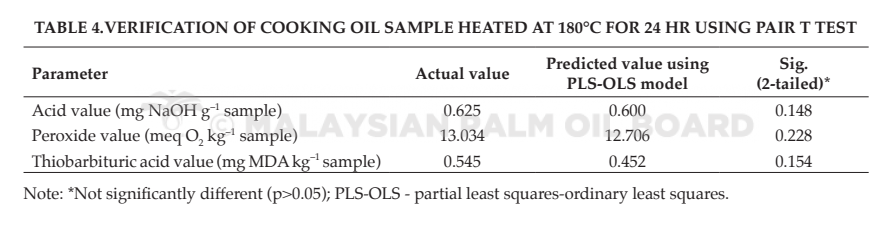
Palm oil is widely used for frying food and is often used for repeated frying up to 40 hr or even longer. Frying causes a gradual quality decrease during heating due to fat oxidation or hydrolysis. The quality of fats and oils is commonly monitored by acid, peroxide and thiobarbituric acid values (AV, PV and TBAV, respectively). This study aimed to use a partial least squares–ordinary least squares (PLS-OLS) model obtained from fourier-transform infrared (FT-IR) spectroscopy to predict AV, PV and TBAV values of heat-treated palm oil. Commercial palm oil was heated at 180oC for 72 hr. The multivariate mathematical models to predict AV, PV and TBAV were generated from the percentages of absorbance intensity of significant wave numbers based on FT-IR readings (721.4 cm–1, 871.8 cm–1, 968.3 cm–1, 1033.9 cm–1, 1095.6 cm-1, 1377.2 cm–1, 1462 cm–1, 1751.4 cm–1, 2731.2 cm–1, 2839.2 cm–1 and 3005.1 cm–1). The PLS-OLS mathematical model satisfactorily predicted both AV and PV for palm oil samples heated up to 72 hr (R2 = 0.962 and 0.857, respectively), whereas for TBAV, the time was 58 hr (R2 = 0.845). This approach provides an alternative to monitoring palm oil quality during frying instead of the conventional methods in which the analytical procedures are time-consuming.
KEYWORDS:FIGURES & TABLES:
1 Department of Food Science and Technology,
Bogor Agricultural University, IPB Campus Darmaga,
PO Box 220 Bogor, 16002 Indonesia.
* Corresponding author e-mail: fkusnandar@apps.ipb.ac.id