Journal of Oil Palm Research Vol. 33 (3) September 2021, p. 524-531
DEVELOPMENT OF PALM-BASED VANASPATI (VEGETABLE GHEE): EFFECTS OF CRYSTALLISATION PROCEDURES ON THE PRODUCT TEXTURE
DOI: https://doi.org/10.21894/jopr.2020.0102
Received: 29 June 2020 Accepted: 14 September 2020 Published Online: 24 December 2020
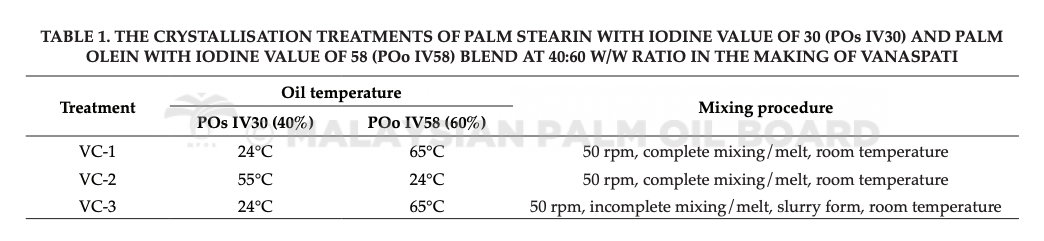
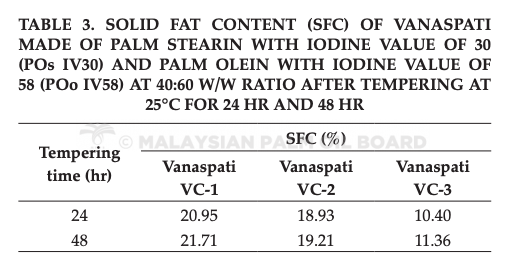
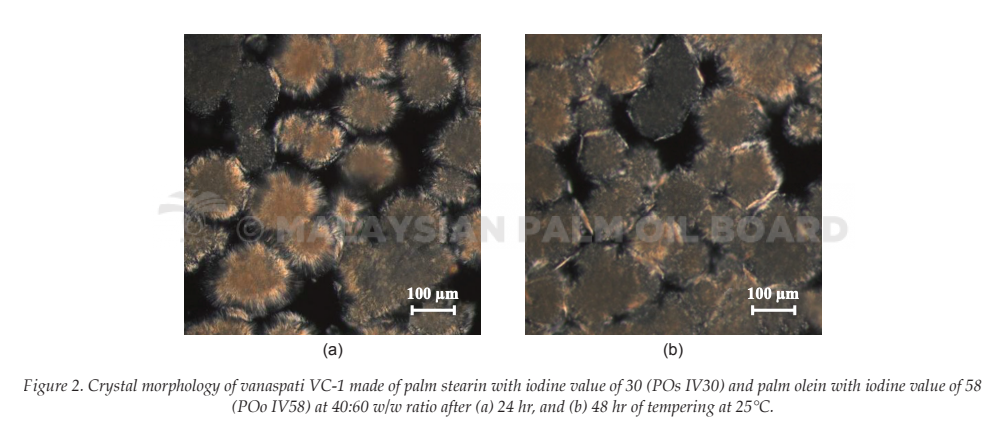
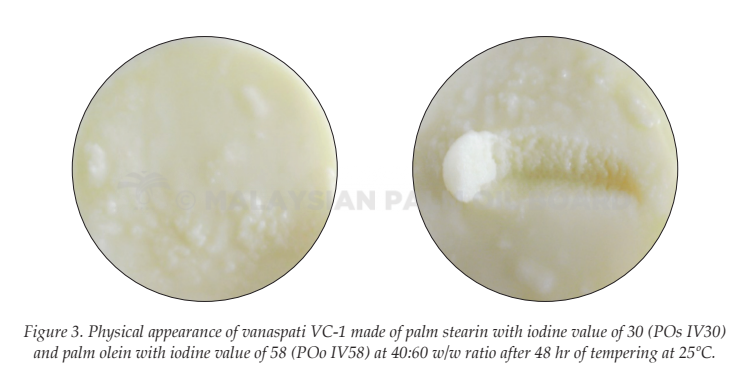
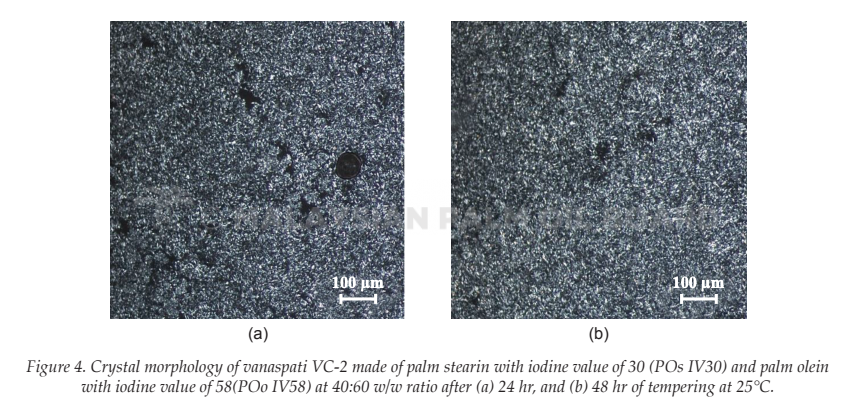
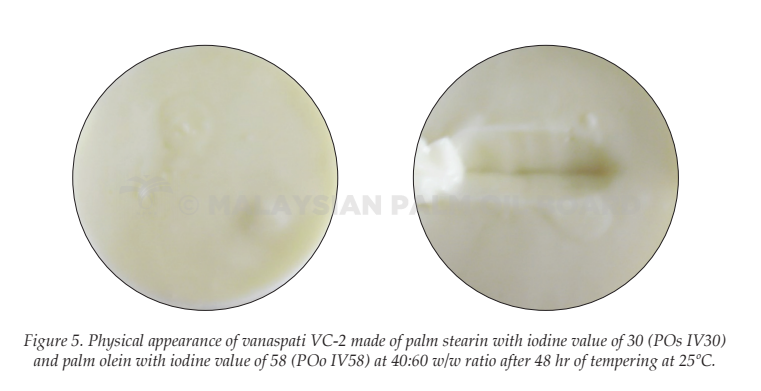
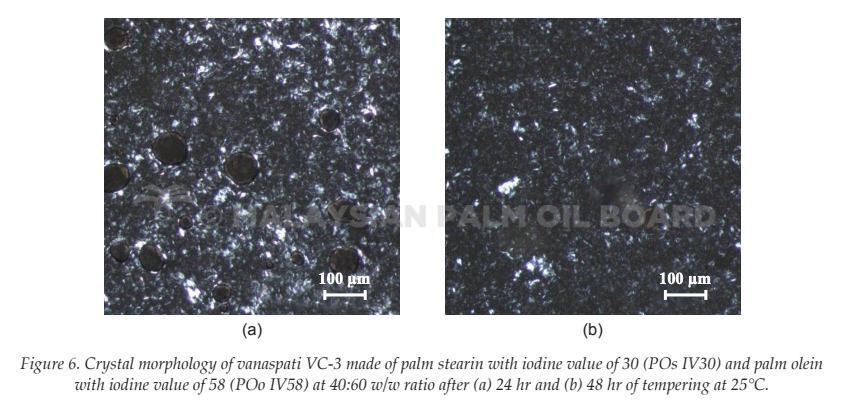
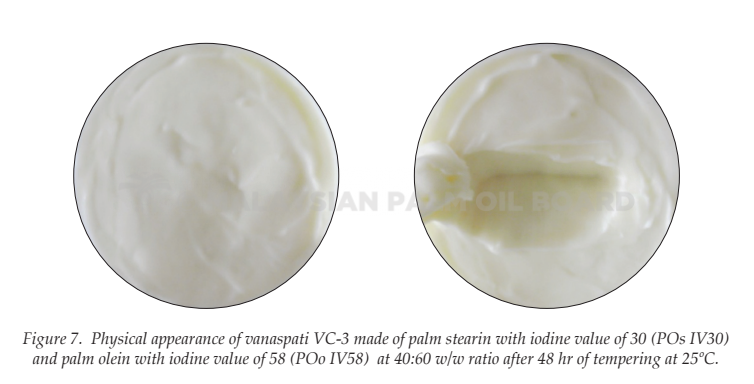
Trans free vanaspati (vegetable ghee) formulated using a blend of refined, bleached and deodourised (RBD) palm stearin with iodine value of 30 (POs IV30) and palm olein with iodine value of 58 (POo IV58) in 40:60 w/w ratio was produced. The effect of mixing procedure on the crystallisation of the blend was investigated. VC-1 treatment which involved mixing of POs IV30 at 24ºC into POo IV58 at 65ºC and mixing the blend to a complete melt at room temperature followed by tempering at 25ºC produced a granulated vanaspati with spherical or granular shape crystals. VC-2 treatment which involved the mixing of POs IV30 at 55ºC into POo IV58 at 24ºC and mixing the blend to a complete melt at room temperature followed by tempering at 25ºC produced small crystals which is suitable for the production of smooth textured vanaspati. Vanaspati produced using VC-3 treatment which involved the mixing of POs IV30 at 24ºC into POo IV58 at 65ºC but was not mixed to a complete melt, followed by tempering at 25ºC produced small crystals and loosely packed structure which led to the formation of a slightly grainy textured vanaspati. Thus, a consistent and homogenous grainy textured vanaspati could be produced under controlled conditions using treatment VC-1 and this will be able to resolve the problem of inconsistency of texture in 100% palm-based grainy vanaspati. Grainy vanaspati is preferred by consumers in India and Pakistan where the demand of vanaspati is very high.
KEYWORDS:FIGURES & TABLES:
1 Malaysian Palm Oil Board,
6 Persiaran Institusi, Bandar Baru Bangi,
43000 Kajang, Selangor, Malaysia.
* Corresponding author e-mail: rafidah@mpob.gov.my